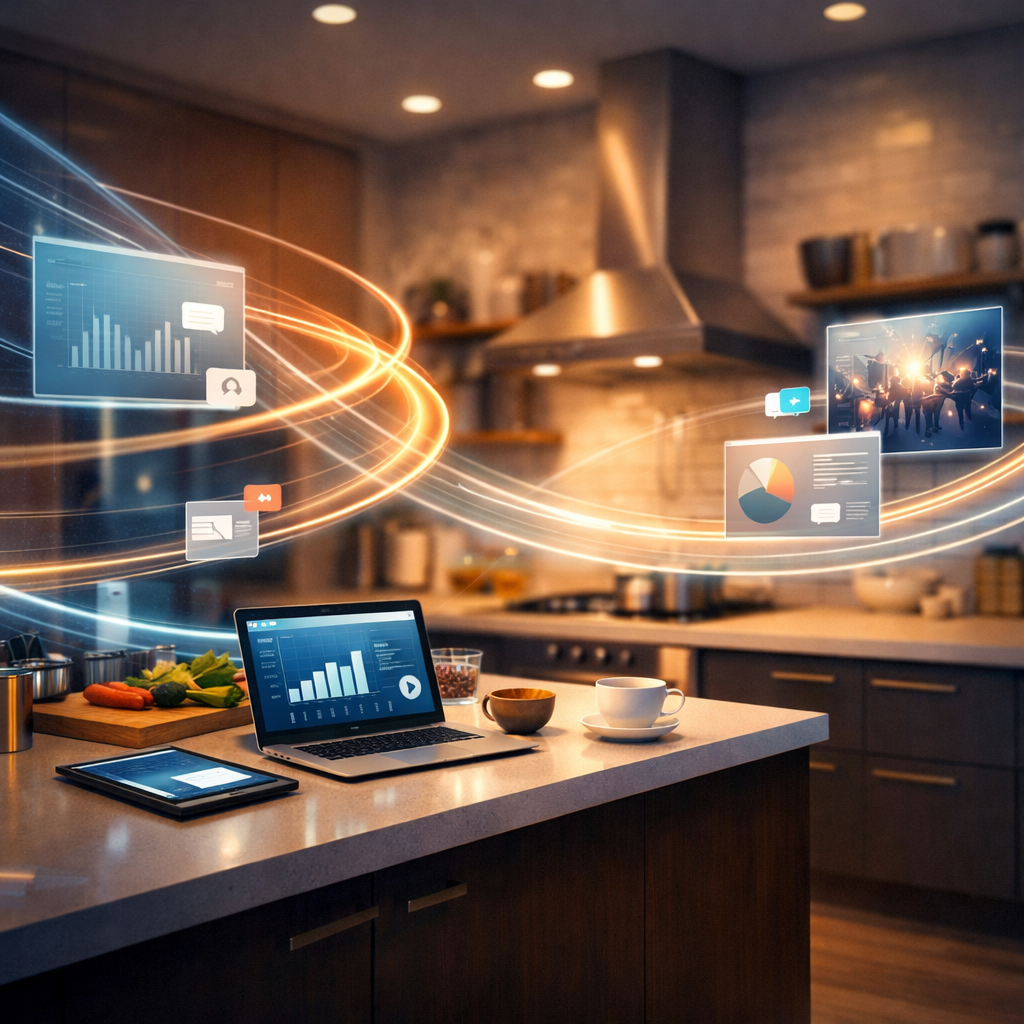
The kitchen has always been a stage for culture, a laboratory where recipes are refined and traditions are passed down. Today it is also a platform. Between streaming cook-alongs, sensor-laden appliances and meal-delivery apps, the contemporary kitchen is wired into digital feedback loops that track tastes, behaviors and trends. Your grandmother’s cookbook has merged with your data dashboard.
Cultural venues and hospitality spaces increasingly function like networked platforms too. Museums gauge visitor sentiment through social-media monitoring and adjust exhibition programming accordingly.1 Restaurants mine reservation data and online reviews to refine menus and operations, turning every plate served into a data point.2 These feedback loops promise responsiveness but also risk flattening difference when metrics trump nuance.
Designers of these systems must balance listening with leading. A constant feedback loop can encourage homogeneity, prompting chefs and curators to chase likes rather than cultivate distinctive voices. Just as a sourdough starter needs time to ferment, creative offerings need breathing room away from the metrics.
Thinking of the kitchen as a platform invites us to be intentional about the loops we create. We can embrace real-time feedback while preserving the serendipity and locality that make our cultural venues vibrant. The challenge is to build systems that nourish rather than commodify, that treat data as dialogue rather than decree.
Written with AI assistance. Sources cited below.
References
- Yuandi Jiang, Kalyna Pashkevych, and Shibo Bi, “Evaluating Visitor Perception and Spatial Preferences of Various Museums Based on Machine Learning from 2016 to 2024,” PLOS ONE (2025). PLOS ONE
- Debjit Roy, Eirini Spiliotopoulou, and Jelle de Vries, “Restaurant Analytics: Emerging Practice and Research Opportunities,” Production and Operations Management 31, no. 10 (2022): 3687-3709. Wiley Online Library

